

A missing page of history · Estate and park
Where the estate boundaries ran
The historic estate boundaries have yet to be compared with maps and today’s park. Copies of the Zalino and Popovo survey book will support that research.
About the fileSources and events
Events, surviving documents and the missing pages of Zelino’s history.
A missing page of history · Estate and park
The historic estate boundaries have yet to be compared with maps and today’s park. Copies of the Zalino and Popovo survey book will support that research.
About the fileAccording to a published study, military clergy decided to establish a candle works to support clergy and their families.
According to a published study, a meeting of military clergy considered a permanent fund for clergy and their families; of three proposals, it chose a dedicated candle works and formed a five-member commission.
The event is reported by a 2024 regional article based on archival and printed materials; the meeting minutes remain the primary source.
A missing page of history · Works
The construction file has already been received. Departmental correspondence about establishing the works has yet to be studied to compare the decisions and their sequence.
About the fileA church candle works for the military and naval departments opened in Zelino. The printed source describes beeswax candle making.
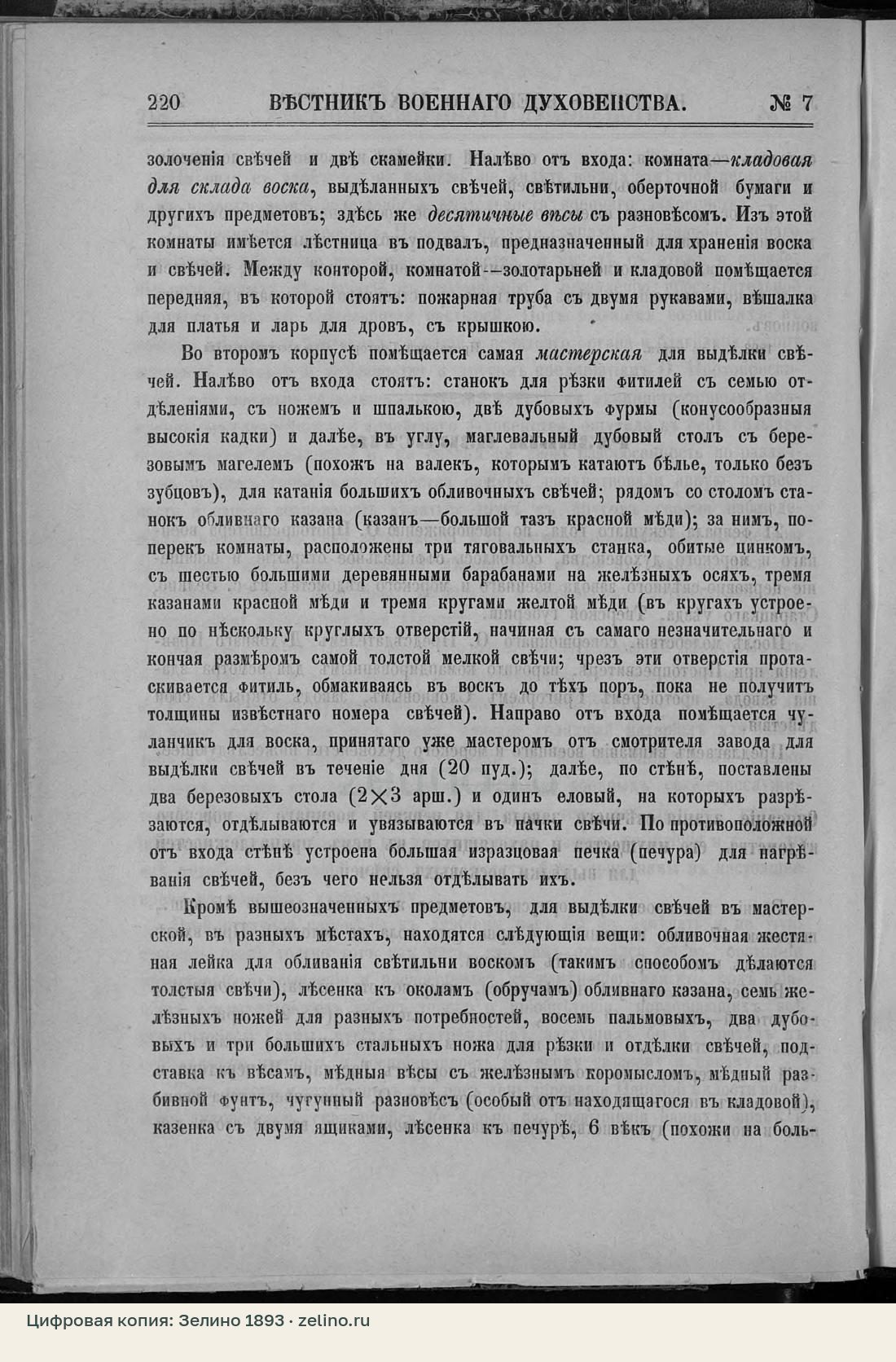
Document · Editorial office of the Military Clergy Herald · 1893
Digital copy from the public corpus of the pre-revolutionary periodical.
Rights: Public domain
Open original sourceThe church candle works of the military and naval departments opened in Zelino under the administration of the Protopresbyter of the military and naval clergy. The source records wax candles, but names no other goods.
The source does not establish the works’ later history or the identity of historic buildings with present-day properties.
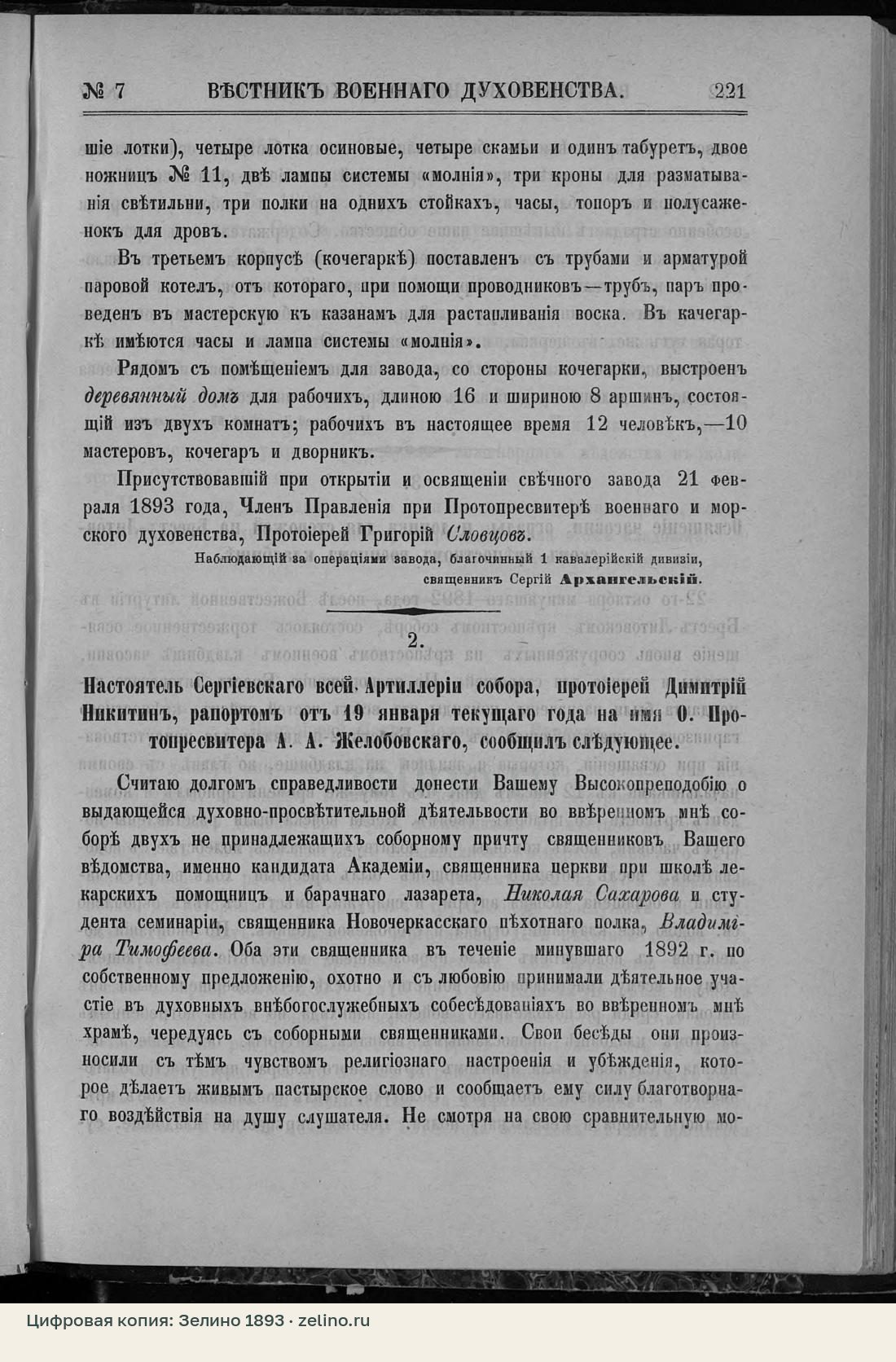
Document · Editorial office of the Military Clergy Herald · 1893
Digital copy from the public corpus of the pre-revolutionary periodical.
Rights: Public domain
Open original sourceA missing page of history · Works
The archive catalogue lists a file about land beneath the candle works donated by Zhelobovsky. The transfer terms need to be checked against the document itself.
About the fileThe local-history account associates the park’s creation with Maria and Konstantin Khokhlov and gives the year 1894.
This is a local-history attribution. The relationship between the described properties and the present park needs investigation.
View evidenceAccording to the study, Archpriest Dmitry Nikitin published an article in issue 23 of the Military Clergy Herald, setting out the case for the works and preliminary financial calculations.
The article is known through a secondary account; issue 23 remains the primary source for verification.
The candle-works project for churches of the military and naval departments followed petitions No. 5444 of 30 July and No. 7558 of 14 October 1892 by Protopresbyter A. A. Zhelobovsky; the Holy Synod authorised the works.
The available record does not give the date of the Synod decree or details of the design process.
The Spiritual Board operated a central warehouse in Saint Petersburg. Branches opened in 15 cities on 1 August and another six on 1 September; military churches received candles and returned candle ends. The documented geographic reach later extended to Port Arthur.
The 1893 lists establish the central warehouse and 21 branches, but not every recipient or uninterrupted operation of every point. Port Arthur is established only as a geographic limit of operations: the source identifies no branch, recipient, individual shipment or route there.
View evidenceAccording to the study, during the 1890s the works sourced wax from the Lüneburg wax bleachery near Hamburg.
Exact years, volumes, contracts and continuity of supply remain unknown; the publication does not identify a separate supplier legal entity.
View evidenceAfter its debt was repaid, the works passed under the Spiritual Board of the Protopresbyter of the military and naval clergy.
The sources identify the end of 1895 but do not give the exact transfer date.
View evidenceThe works continued candle production and accepted returned candle ends; no verified account of the full product range or year-by-year operations is yet available.
The interval shows the established administrative frame, not proof of uninterrupted operations on every day or in every year.
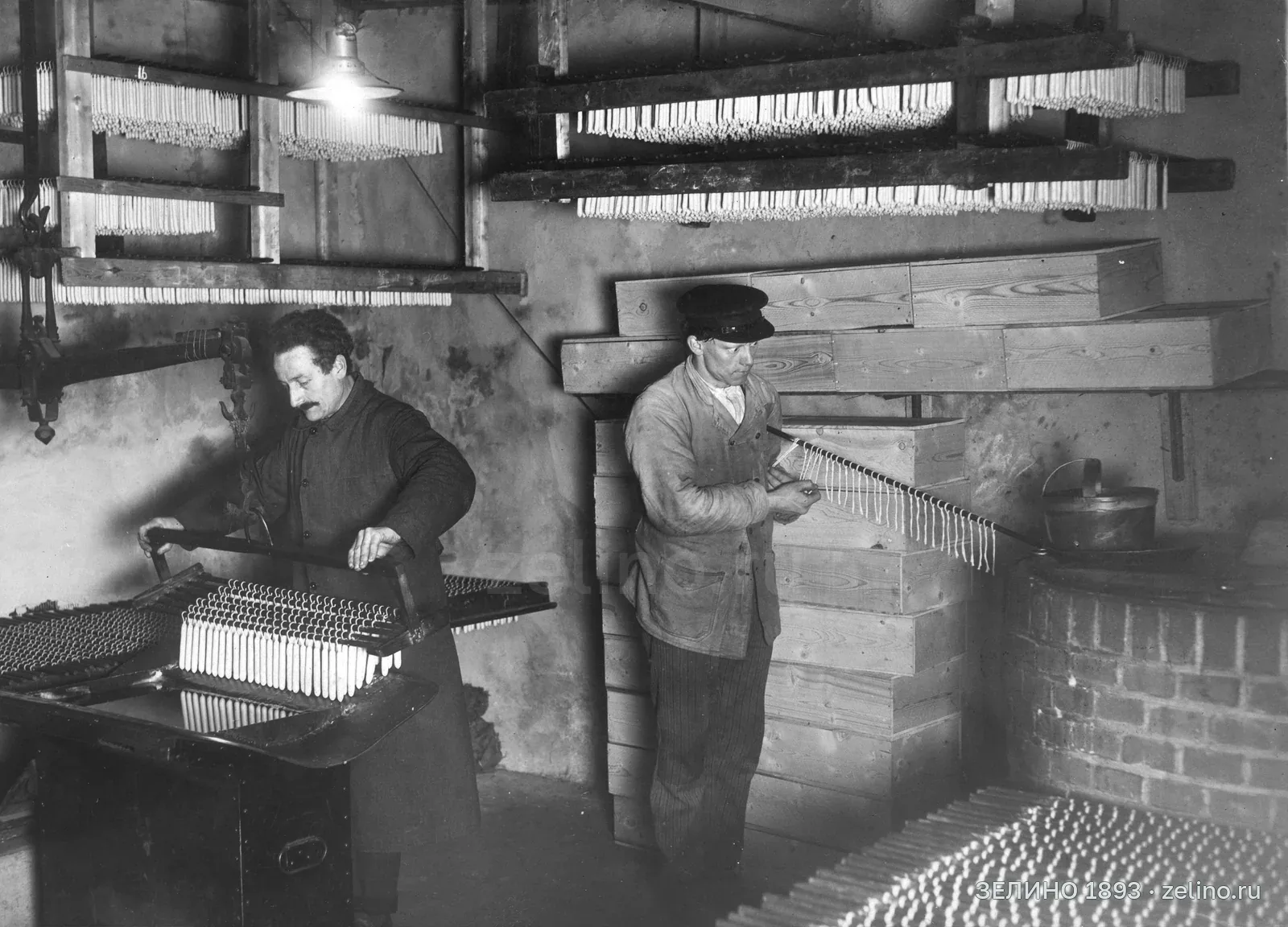
Historical photograph · Photographer unknown · 1915
Rights: Public domain
Open original sourceAccording to the study, the Holy Synod established a three-clergyman committee at the Spiritual Board in Saint Petersburg; K. I. Khokhlov is named as the first overseer of the works.
Only the role in managing the works is supported; biographical and portrait evidence has not been established.
According to the study, 3,941 poods of candles had been made since opening, the works paid for itself in three years, and net profit for the first seven years was 60,000 roubles.
The figures are reported by a secondary publication; the underlying accounts are not available on this website.
View evidenceAccording to the study, profits supported widows and orphans of the military clergy, grants, a funeral fund and the construction of almshouses.
The publication lists uses of funds but does not provide one common period or a complete set of accounts for all sums.
View evidenceThe questionnaire names E. I. Zhukova and M. I. Pleskovskaya and describes a two-storey house. Its location relative to today’s park is being investigated.
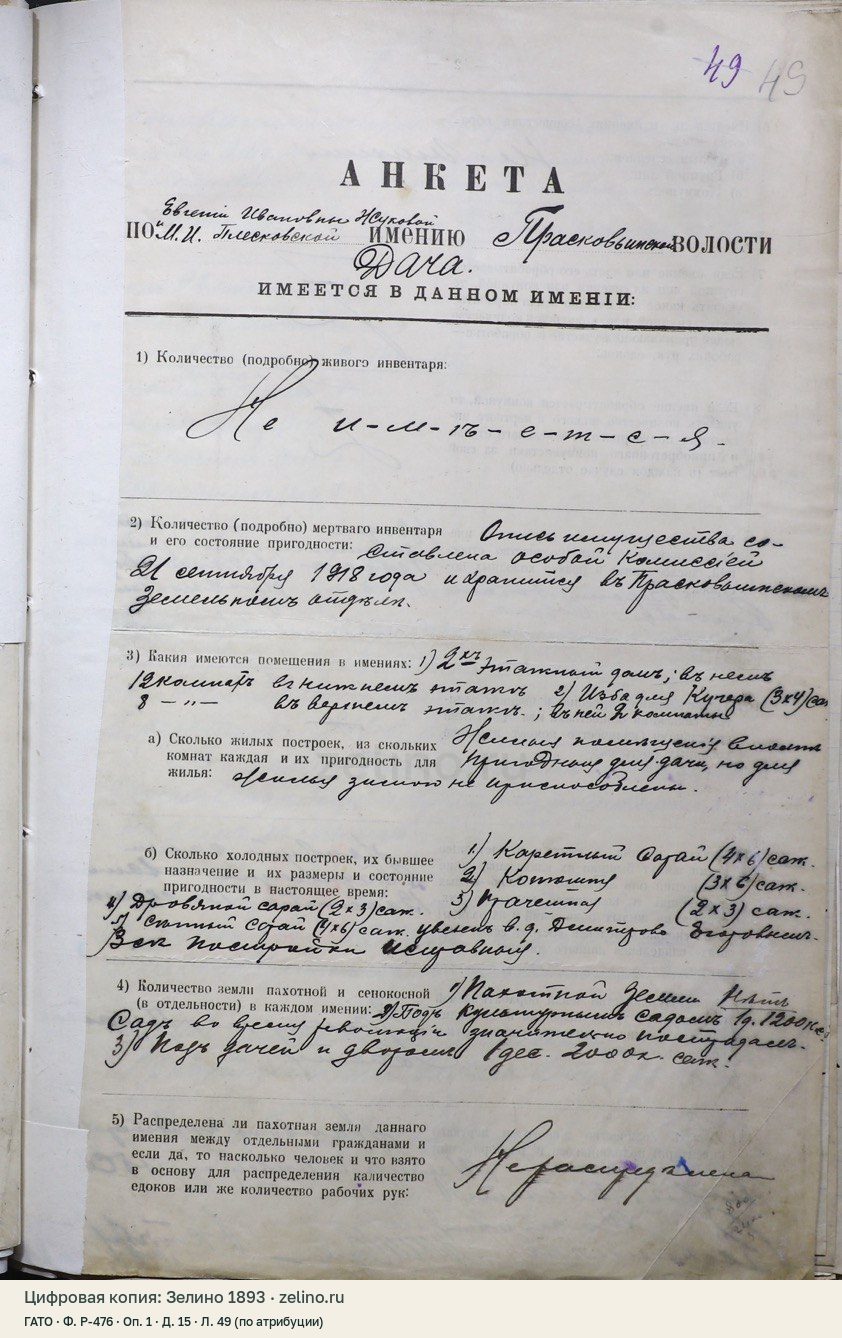
Document
Rights: The copy was supplied to the project with permission for public use from its provider. No open licence is claimed.
Open original sourceThe document establishes the names and composition of the estate. Its historical extent has not been matched to today’s protected-area boundary; the date of 5 October and full archival reference are not visible in this image.
View evidenceAccording to technician Andrianov’s December report, the works had not operated since 23 July 1918.
This does not establish permanent closure. The cause and subsequent operation are unknown; a related act mentions a lack of benzine but does not prove a causal link.
View evidenceTechnician Andrianov described the workforce, manual candle making, a boiler and extraction equipment. The report does not establish that the equipment was operating during the survey.
The report lists thirteen labourers and three employees, manual candle making, a 1908 boiler, two extractors, two Worthington pumps, a saw frame, electric light, three wagons and about 150 sazhen of rail.
The day field in the date line is blank. The report supports the equipment classes and rated capacities, but not operation at the moment of survey, specific models or spatial arrangement.
View evidenceB. V. Ositiansky described the Staritsa works’ comb-foundation and extraction departments. His article reports a usual workforce of 50–60.
B. V. Ositiansky’s article reported that the works was administered by the Kalinin Beekeeping Office, had comb-foundation and extraction shops, and normally employed 50–60 people.
The figures and assessments concern the condition reported by the author in 1938–1939; they do not establish uninterrupted operation, present buildings or the current site.
View evidenceThe VSNKh resolution of 25 January 1919 transferred the wax industry to Tsentrozhir and nationalised diocesan candle works. The Zelino works had already been under the Labour Department since May 1918.
The sector-wide resolution and the works’ initial Soviet supervision are separate events.
View evidenceIn 1943, the Staritsa Wax Extraction Works was restored and commissioned. It produced industrial wax and comb foundation for agriculture.
The sources do not establish the date of destruction or the full extent of reconstruction.
View evidenceThe journal table records 77.6 tonnes of extraction wax and 33.3 tonnes of artificial comb foundation produced in 1954.
A journal table reports 77.6 tonnes of extraction wax and 33.3 tonnes of artificial comb foundation against plans of 60.5 and 33.0 tonnes respectively; the article also lists extraction equipment.
The table was visually checked against the journal page but is not a substitute for accounts; its figures apply only to 1954. Catalogues identify issue 11, while the page footer reads issue 10.
Sorted wax refuse
Artificial comb foundation
Extraction wax
Natural wax
Wax alloy
Floor mastic
Financial figures · thousand roubles
Product value
Profit
Zelino Park was designated a regional natural monument on 30 July 1986.
This date concerns protected status, not the planting of the historic park.
View evidenceA Tver State University publication describes six directors’ personnel files in TCDNI fond R-62, documenting appointments, departures and the factory’s personnel administration.
The publication gives the files’ composition and archival references; personal attribution requires verification against the archive records.
View evidenceThe Staritsa Wax Extraction Works operated as a unit of the Kalinin Regional Beekeeping Office, producing comb foundation, press wax and extraction wax.
The archive files support the period’s production profile, but not uninterrupted output of every product; the photograph’s date, operation and workers’ names are unknown.
View evidenceThe wax-extraction works was granted 3.4 hectares for production. The certificate does not establish present-day boundaries or legal succession.
On 17 September 1992, the Staritsa District Council of People’s Deputies granted the wax extraction works in the Pankovo Rural Council area of Staritsa District 3.4 hectares of land for indefinite (permanent) use for production purposes. Certificate No. 73, dated 6 January 1993, formalised the right.
The certificate establishes that the works existed as an independent land user in the Pankovo Rural Council area around 1992–1993. It does not establish present cadastral boundaries, continuation of the right, legal succession or identity with present-day properties.
View evidenceA complex record and five building records documented historic structures. Their correspondence with present-day buildings requires separate verification.
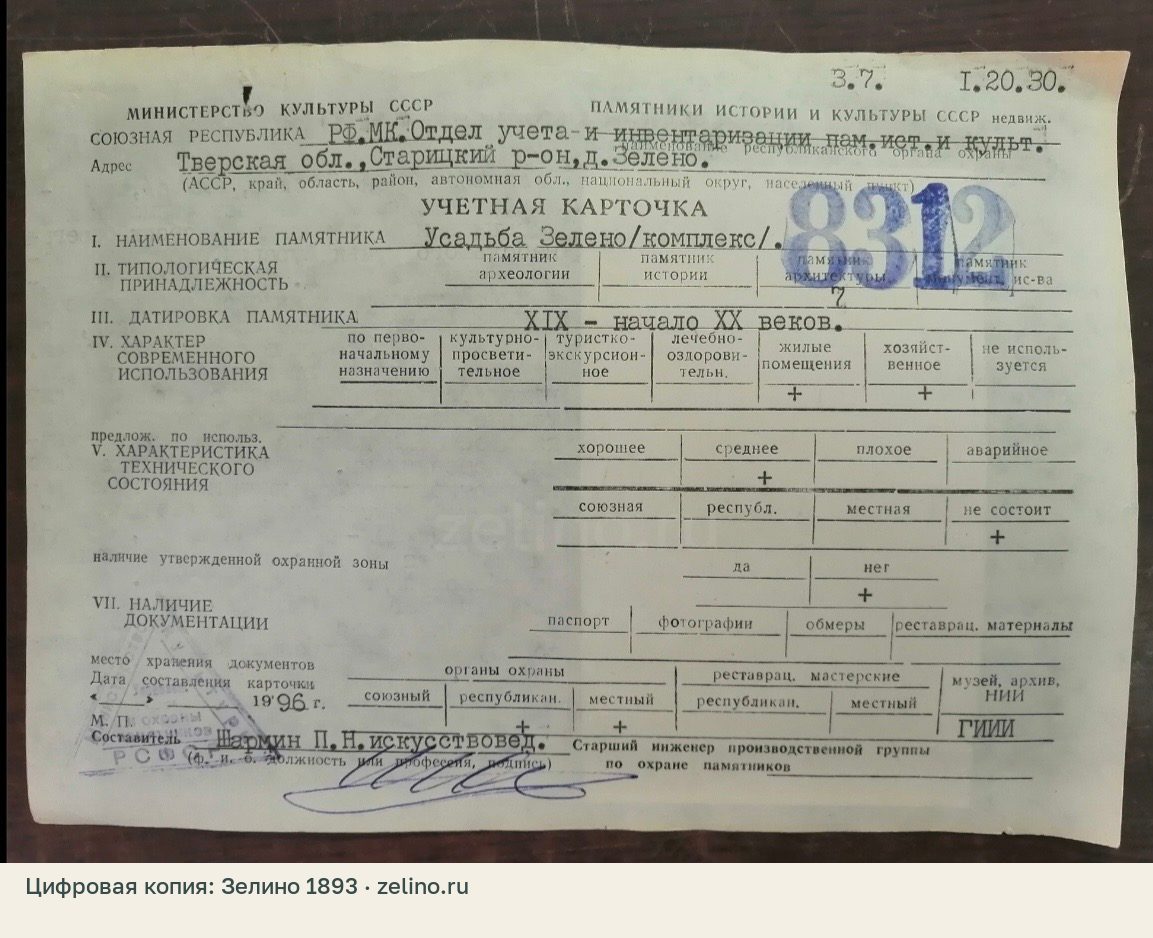
Document · 1996
The original record accompanies the event’s text transcription.
Rights: Rights held by the project
Open original sourceArchive record 8312 contains a complex card and five component cards: two service buildings, a workers’ house and two production buildings.
All six cards are dated 1996. They do not establish identity with present cadastral buildings, present condition or construction dates.
View evidenceWorker A. S. Bibicheva’s recollections of the workforce, departments and wax shipments by rail were published.
The Staritsa Herald published an account by former worker A. S. Bibicheva, who recalled a workforce of about 50, extraction, press-wax, comb-foundation, fitting and sewing shops, the processing of wax residues and shipment of technical wax by rail.
This is memory testimony containing approximate figures; it does not establish uninterrupted operation of every shop or the exact period of each process.
The project working archive contains technical passports for two production buildings compiled on 24 April 2007.
The document date is not a construction date; the passports do not establish identity with historic buildings or describe condition in 2026.
View evidenceThe Staritsa Herald published a synthesis of archival and printed evidence about the creation and operation of the candle works.
The article is a secondary synthesis; primary documents retain priority for disputed dates and figures.
View evidenceThe Zelino 1893 project is assembling sources and preparing a programme for preservation and future use of the historic site.
The record does not establish resumed production, completed restoration or the buildings’ technical condition.
View evidence1893–1918
1918
1939–1993
2026
1890–1918
verified in a primary sourceMilitary Clergy Herald, issue 7 — English editorial or search variant
1890–1918
search wordingEnglish editorial or search variant
December 1918
verified in a primary sourceTechnician Andrianov’s survey of the candle works — Editorial translation of the first paragraph on folio 7 of the 1918 file
1939
verified in a primary sourceB. V. Ositiansky, “The Staritsa Wax Extraction Works” — Editorial translation of the short form in the opening paragraph of the 1939 article
1939–1955
verified in a primary sourceB. V. Ositiansky, “The Staritsa Wax Extraction Works” — Editorial translation of the titles published in 1939 and 1955
17 September 1992–6 January 1993
verified in a primary sourceCertificate No. 73 for indefinite (permanent) use of land — Editorial translation of the land-use subject in the decision and certificate
Each event links to its sources. Secondary accounts are identified as such, with material limitations alongside each conclusion.
The correspondence on establishing the candle works is needed to compare the decisions behind its creation.
About the file