Two riveted iron extractors—up to 655.2 kg each, about 1.31 tonnes of simultaneous charge.
Material and process
Wax and comb foundation: production history in Zelino
Archival evidence about wax processing, equipment and comb-foundation production on the site.
Primary source · December 1918
Benzine wax extraction at Zelino
Andrianov’s report and the related survey act provide a quantified view of the extraction section. Documentary fact is separated from technical reconstruction.
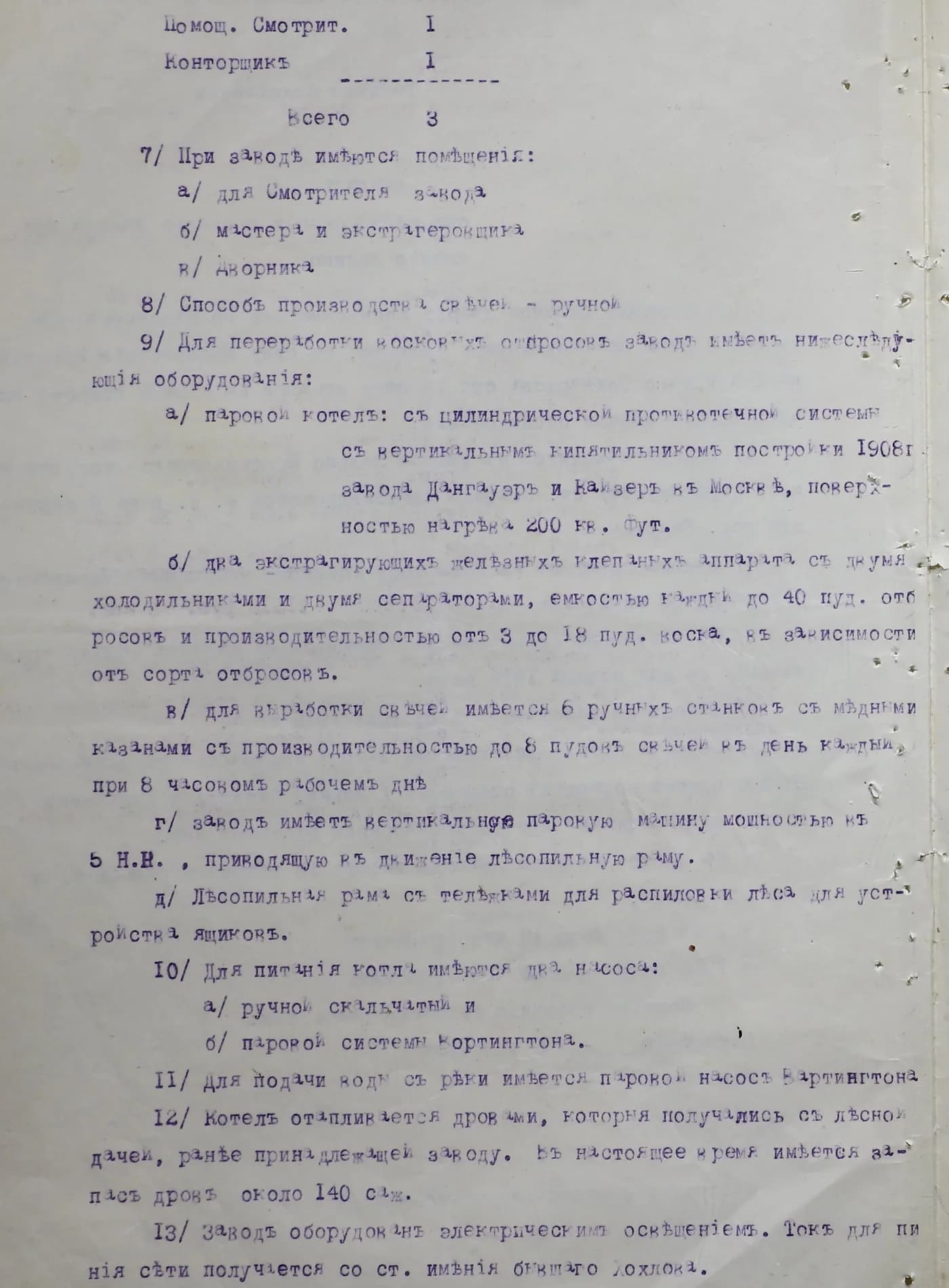
Stated yield per vessel: roughly 49–295 kg of wax, depending on the waste grade.
Two coolers and two separators. Their presence is established; the separator duty and pipework are unknown.
The related act requested this amount for a year’s work. Benzine as a process solvent is a fact of the file, not an analogy.
Why the annual figures do not form one balance
A mean yield of about 15% from the stated 25,000 poods of waste would give 3,750 poods of wax, below the stated capacity of 10,000 poods of candles. Stocks separately included 181 poods of Japanese wax, 2,980 poods of waste and fifty poods of candles. The figures therefore belong to different production circuits and do not show that all candles came solely from wax extracted on site.
V2 · Period terminology In late nineteenth- and early twentieth-century industrial chemistry, a “cooler” commonly meant a cooled condenser rather than a modern compression refrigerator. This explains the class of apparatus, not the exact construction at Zelino.
V3 · Probable reconstruction Distillation, condensation and possible benzine return are supported by period analogues and the coolers, but the exact Zelino sequence is not described.
The technical study is continuing.
Place in the history of the site
Wax extraction appears in the 1918 records and became the principal production profile of the Soviet period.
History of the site and its names
What the wax terms mean
Beeswax is wax material of bee origin. Colour alone does not establish a batch’s purity, origin or suitability.
Yellow beeswax means wax retaining a natural yellow colour after initial preparation. The project uses it as a historical and research term.
Bleached beeswax is wax whose colour has been lightened by a bleaching operation. An archival mention of that operation is not a ready modern formula.
Cleaning, processing and bleaching
Wax preparation may include removing mechanical impurities, separating batches and checking properties. The exact parameters of a modern process are determined through research and trials.
Current status: the archival process is under study; a modern production specification and any list of manufactured grades must be supported by trials and publication records.
Directions under research
Yellow and bleached beeswax are considered in historical and process contexts. Candle wax and wax blends are possible development directions. Soy, coconut, rapeseed, paraffin and microcrystalline waxes are listed only for future evaluation: the project does not claim to manufacture, process, sell or establish environmental properties for them.
B2B scenario and minimum evidence
Before offering material or contract processing, the supplier and batch origin, composition and grade, purity and moisture indicators, melting point and other applicable properties, test methods, quality certificate, labelling, traceability, batch volume, storage and contractual responsibility must be established. Suitability for candles, conservation, craft or industry requires separate evidence.
A separate indexable product page is allowed only for a genuinely available batch or service with useful standalone content, verified specifications, documents, seller, price and supply terms. Until then, thin pages for individual wax types are not created.